

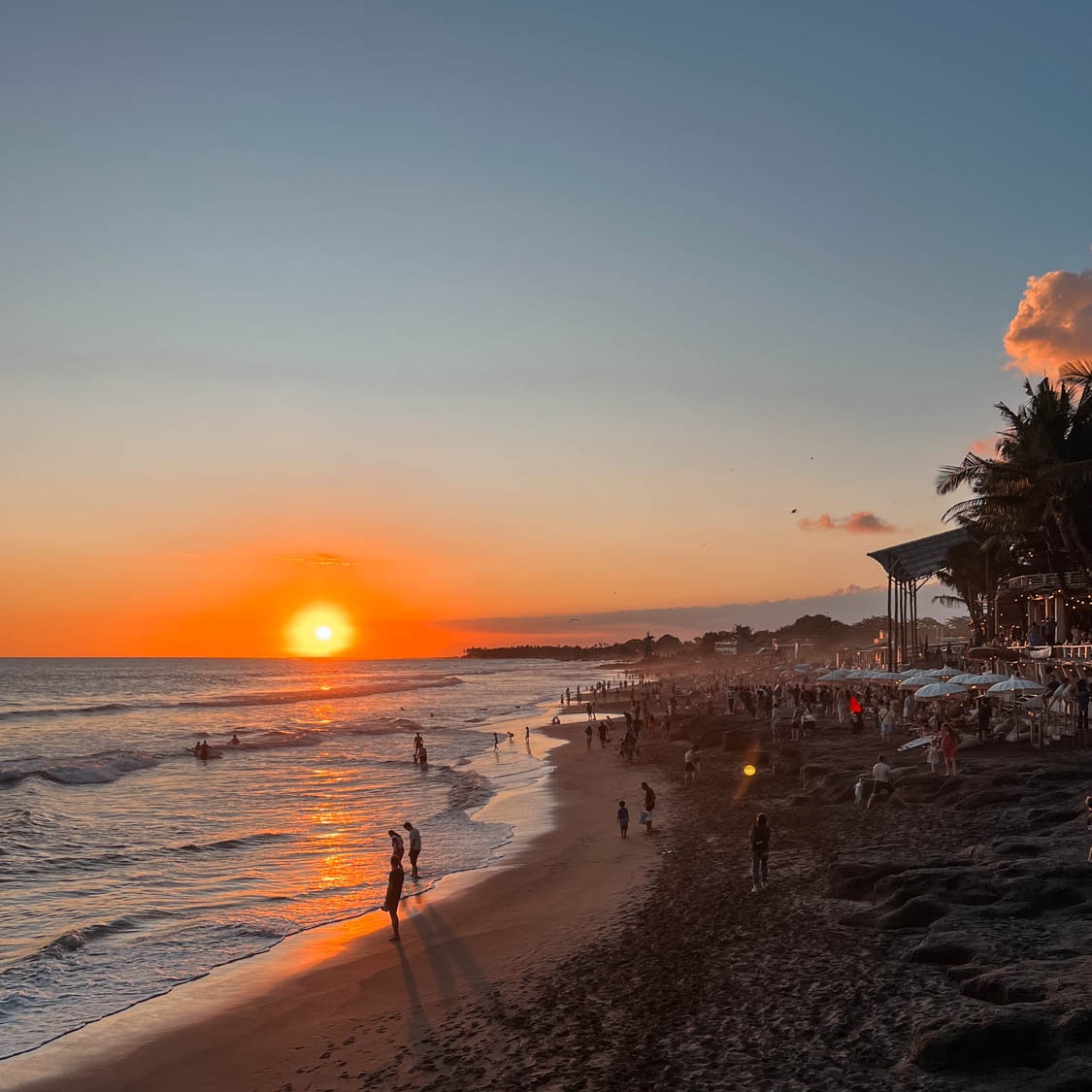
One Coastline, Many Names
Ask five people what “Canggu Beach” means and expect five different answers. Some picture the crowd in front of Finns Beach Club in Berawa.
Others mean the surf break at Batu Bolong, or the sunset seafood stalls at Echo Beach, or the quiet rice-field-backed sand further north at Pererenan.
All of these answers are correct, because Canggu’s coastline runs as one long, continuous stretch of black sand, carved by locals and long-stay visitors into named sections based on the nearest access road rather than any real geological break. Walk south to north along the shore and the beach never truly ends.
Only the name changes.
This guide walks through each named section, what makes each one different, how safe the water runs, and which stretch fits which kind of visitor.
Why Canggu’s Beaches Look and Feel the Way They Do
Every beach in Canggu shares the same black volcanic sand, a direct result of Bali’s geology rather than pollution or poor maintenance, despite how the color sometimes reads in photos. The sand absorbs heat fast under direct sun, so flip-flops or reef shoes matter more here than on a typical white-sand beach, particularly from mid-morning onward.
The coastline sits fully exposed to the Indian Ocean, with no fringing reef or bay to soften incoming swell the way Sanur or Nusa Dua enjoy further east and south. This exposure is exactly what built Canggu’s surf reputation, and this same lack of protection explains why none of these beaches function as calm swimming spots in the way visitors from other coastlines might expect.
The absence of a reef also shapes the daily rhythm of the beach itself. Waves break directly onto the sand rather than dissipating offshore first, so the shore break often feels more forceful underfoot than the wave height alone suggests, even on a visually calm day.
First-time visitors often underestimate this force, since a chest-high wave breaking directly on shore carries considerably more push than the same wave breaking over a distant reef.
Tides matter more here than most visitors expect too. Low tide exposes more sand and generally calmer shallows for wading, while high tide pushes the shore break closer to the beach access points and narrows the dry sand considerably, sometimes to almost nothing during the biggest swells of the wet season.
Batu Bolong Beach: The Most Popular Stretch
Batu Bolong Beach sits at the end of the main Jalan Batu Bolong strip, making this the most accessible and most crowded beach in the area. A small temple perched on a rock outcrop gives the beach its name and marks the surf break offshore, a spot welcoming everyone from complete beginners taking their first lesson to experienced surfers working the peak.
Beach bars and warungs line the sand directly, so a sunset drink or a plate of nasi goreng never requires leaving the beach itself. This density is the tradeoff for the convenience: expect company, especially between 4 PM and sunset when the whole strip fills in.
Casual visitors wade and paddle close to shore here more comfortably than anywhere else in Canggu, though swimming out past the break still calls for confidence and awareness of the current.
Beyond the temple and the surf break, Batu Bolong Beach also functions as the main sunset viewing spot for the whole neighborhood. Rows of plastic chairs and low tables appear along the sand from roughly 4:30 PM, run by the same beach bars lining the strip, and a cold Bintang here while watching the day’s last surfers ranks among Canggu’s most repeated rituals for both tourists and long-term residents.
Parking a scooter near the beach access road gets harder the closer sunset approaches, so arriving on foot or by ride-hailing after 4 PM tends to work better than driving in.
Echo Beach: Stronger Surf and a Quieter Sunset Strip
Echo Beach sits a short walk west of Batu Bolong and carries a noticeably different character. The surf runs stronger and more consistent, drawing intermediate and advanced surfers specifically, and a row of seafood warungs faces the water rather than the dense cafe cluster found on the main strip.
Sunsets here rank among the most reliable in the area, with fewer people crowding the sand compared to Batu Bolong at the same hour. Currents at Echo Beach run strong enough, and casual swimmers and families with young children should stay close to shore or skip swimming altogether, sticking to watching the surfers instead.
One practical note worth knowing ahead of a visit: local transport arrangements mean ride-hailing drivers cannot reach all the way down to the sand at Echo Beach, so budget a short walk from the drop-off point.
Echo Beach also carries a slightly older, more settled crowd than Batu Bolong most afternoons, drawing long-stay surfers and residents alongside tourists rather than the backpacker-heavy mix found closer to the main strip. The seafood warungs facing the water grill the day’s catch to order, and a meal here around 6 PM, right as the sun drops behind the horizon, remains one of the better value experiences along this whole stretch of coast.
Berawa Beach: The Calmest of the Group
Berawa Beach offers the gentlest conditions among Canggu’s named beaches, making this the closest option to a genuine relaxation beach rather than a surf-first destination. Sunset walks and beachfront dining suit Berawa better than active swimming, and the beach sits within walking distance of Finns Beach Club and Atlas Beach Club, both major draws in their own right.
Even at its calmest, Berawa Beach is not equivalent to the protected, reef-sheltered beaches at Sanur or Nusa Dua. Currents still run here, and the absence of a fringing reef means conditions shift with the swell and tide through the day.
Berawa’s beach clubs deserve a separate mention on their own, since Finns Beach Club and Atlas Beach Club, the latter recognized as one of the largest in Southeast Asia, both sit directly on this stretch and shape much of the daytime crowd. Poolside loungers, live music, and a resort-style day-pass experience sit a short walk from the open sand, giving Berawa a split identity: relaxed public beach on one side, high-energy beach club scene on the other, depending on which direction a visitor turns after stepping onto the sand.
PROPERTIA’s guide to Canggu’s beach clubs breaks down pricing and vibe at both venues in full.
This beach club energy is a big part of why villas within walking distance of this stretch hold their value so well. A scroll through what’s currently listed near Berawa Beach shows exactly how much of a premium this proximity commands.
Pererenan Beach: Quiet, Rice-Field-Backed, and Built for Surfers
Pererenan Beach sits furthest north of the four main sections and offers the quietest, least developed stretch of sand in Canggu. Rice paddies frame the beach on the landward side, creating a rural backdrop unlike anything closer to central Canggu, and far fewer tourists make the trip out compared to Batu Bolong or Berawa.
The waves here suit intermediate and advanced surfers, with a stronger, less forgiving break than Batu Bolong’s beginner-friendly peak. Swimming is not recommended for casual visitors, and the beach’s local, low-key atmosphere means fewer amenities directly on the sand, mostly small warungs and coconut stalls rather than beach clubs.
Access to Pererenan Beach itself takes a short walk or scooter ride from the main road through active rice paddies, an approach setting the mood before the ocean even comes into view. Morning visits reward early risers with a nearly empty beach and soft light over the surrounding fields, a noticeably different experience from the packed sunset scenes further south.
Visitors staying in Pererenan or nearby Cemagi tend to treat this beach as a daily routine rather than a single outing, since the quiet holds through most of the day outside of the surf’s peak hours.
Nelayan Beach: The Overlooked Middle Ground
Nelayan Beach sits close to Batu Bolong but stays noticeably quieter, known locally for its fishing boats rather than any beach club or surf school. Few tourists make a specific trip to Nelayan, which is exactly its appeal for visitors who want proximity to Batu Bolong’s convenience without its crowd.
Coworking spaces, yoga studios, and early-closing cafes cluster in the neighborhood behind the beach rather than beach bars on the sand itself, giving Nelayan a more residential feel than its neighbors.
Best Time of Day and Year to Visit
Sunset draws the biggest crowds across every Canggu beach, typically building from around 4:30 PM and peaking in the final thirty minutes before the sun drops below the horizon. Anyone wanting a quieter experience does better arriving at sunrise instead, when the sand sits nearly empty and the light suits photography better than the golden-hour crush most visitors chase later in the day.
Bali runs two broad seasons. The dry season spans April through October, bringing more consistent surf and generally calmer swimming conditions, while the wet season from November through March brings bigger swells, stronger rip currents, and the annual jellyfish bloom described in the safety section below.
Surfers often prefer the wet season specifically for the larger swell, while families and casual swimmers get an easier experience during the dry months.
Weekdays run noticeably quieter than weekends at every beach covered here, since Bali’s own residents and long-term expats treat Saturday and Sunday as the default beach day alongside visiting tourists. A Tuesday morning at Batu Bolong feels like a different beach entirely compared to the same spot on a Sunday afternoon.
Getting to Each Beach
Scooter remains the most practical way to reach any of Canggu’s beaches, with parking available near most main access points, though spots fill quickly during peak sunset hours at Batu Bolong specifically. Grab and Gojek both operate throughout the area, with the notable exception of Echo Beach’s final stretch, where a local transport arrangement means riders should expect to walk the last few hundred meters from the drop-off point to the sand.
Walking between beaches along the shore works well at low tide, particularly the stretch connecting Berawa, Batu Bolong, and Echo Beach, though high tide often narrows the passable sand considerably and occasionally cuts off the walking route between sections entirely. Pererenan sits far enough north to make walking the full distance from Batu Bolong impractical, and a scooter or short ride-hailing trip works far better for this leg of any beach-hopping day.
Swimming Safety: What Every Visitor Needs to Know
Canggu’s beaches are surf beaches first, and every visitor should plan around this fact rather than around expectations set by calmer coastlines elsewhere. Rip currents and strong shore breaks appear across the whole stretch, and Badung Regency’s lifeguard service, known as Balawista, patrols only a limited number of Bali’s beaches with the red-and-yellow flag system familiar from Kuta, Legian, and Seminyak.
Most of Canggu’s beaches fall outside this patrolled zone.
Treat any Canggu beach without a visible flag or lifeguard tower as swim-at-your-own-risk, regardless of how calm the water looks from the sand. Conditions shift through the day with the tide, and a section manageable at 9 AM often carries a real rip current by early afternoon.
A few practical points worth keeping in mind:
- Red flags mean stay out entirely. Where flags do appear on nearby beaches, a solid red flag signals a firm no-entry warning from Badung’s lifeguard service.
- Rip currents pull sideways or outward, not under. The safest response is swimming parallel to shore until free of the pull, rather than fighting directly against the current.
- Jellyfish season runs November through March, tracking with Bali’s wet season and peak swell. Stings are treated with vinegar, not the old freshwater or urine remedies still repeated online.
- Children and non-swimmers should stay close to shore at every beach covered here, with Berawa and Batu Bolong offering the most forgiving conditions of the group.
- Sanur and Nusa Dua remain the closest true swimming beaches, both roughly 45 minutes to an hour away and worth the drive for anyone traveling with young children who want to swim rather than watch surfers.
Surf schools operating along Batu Bolong and Echo Beach provide a practical middle ground for visitors wanting ocean time without the full risk of heading in alone. Instructors watch conditions daily and adjust lesson locations accordingly, and a supervised first session gives newcomers a far better read on the area’s currents than guessing from the beach.
None of this safety picture should discourage a visit. Millions of travelers enjoy Canggu’s beaches every year without incident, and the same surf making casual swimming risky is precisely what draws surfers from across the world to this stretch of coast.
Respecting the ocean here means reading conditions before entering the water, not avoiding the water altogether.
Surf Conditions Compared
Surf lessons, board rental prices, and full break-by-break detail sit outside the scope of a beach guide, and PROPERTIA’s Canggu surf guide covers this ground for anyone planning a session rather than a swim.
| Beach | Best For | Board Type | Swell Direction | Consistency |
|---|---|---|---|---|
| Batu Bolong | Beginners to intermediate | Longboard or fish | SW/N | Consistent |
| Echo Beach | Intermediate to advanced | Shortboard | S/N | Inconsistent |
| Berawa | Casual paddling, not a surf hub | N/A | SW | N/A |
| Pererenan | Intermediate to advanced | Shortboard or fish | NE | Consistent |
Comparing the Beaches at a Glance
| Beach | Vibe | Crowd Level | Best Time to Visit |
|---|---|---|---|
| Batu Bolong | Social, beginner-friendly surf | Highest | Sunrise for quiet, sunset for atmosphere |
| Echo Beach | Stronger surf, sunset dining | Moderate | Late afternoon into sunset |
| Berawa | Calm, beach-club adjacent | High near clubs | Morning for a walk, evening for dinner |
| Pererenan | Quiet, rural, surf-focused | Lowest | Early morning |
| Nelayan | Local, residential | Low | Any time, rarely crowded |
Choosing a Beach for Your Situation
Traveling with young children: Berawa Beach offers the calmest water of the group, and its proximity to Finns and Atlas Beach Club means shaded loungers, pools, and food options are close by rather than a separate trip.
Learning to surf for the first time: Batu Bolong’s beginner-friendly break and concentration of surf schools make this the natural starting point, with instructors used to working with complete beginners.
Chasing a serious surf session: Echo Beach and Pererenan Beach both offer stronger, more technical waves suited to surfers who already know what they are doing.
Wanting a quiet sunset without a crowd: Pererenan or Nelayan deliver a similar sunset with a fraction of the people found at Batu Bolong or Berawa at the same hour.
Considering a beachfront or near-beach property purchase: Berawa carries the strongest established rental demand of the four main areas, reflected in the highest average daily rates in the wider Canggu market. Pererenan trades some of this rental strength for a lower entry price and a stronger growth trajectory, worth a look through available Pererenan villas and land for anyone weighing the two against each other. PROPERTIA’s investment guide by area breaks down entry prices and yield expectations for both side by side, and the complete guide to buying property in Bali as a foreigner covers the ownership structures available before making an offer.
Planning a full day rather than a single stop: Combining beaches works well given how close the four main sections sit to each other. A common route runs a quiet sunrise session at Pererenan, lunch and a wander through Batu Bolong at midday, and sunset drinks back at Berawa or Echo Beach, covering the full range of what this coastline offers within a single day without repeating the same view twice.


